Shoulder labrum repair and instability surgery in Cincinnati
Dr. Robert Pettit treats labral tears and shoulder dislocations in athletes and active adults with arthroscopic labral repair, and with the Latarjet procedure when bone loss makes a soft-tissue repair unlikely to hold.
- Board certified, ABOS
- Sports medicine fellowship, Harvard & Tufts (NEBH)
- Cutting-edge technology, minimally invasive techniques
- Same-week appointments
- 4.9★ · 361 Google reviews
Is this surgery right for you?
- Your shoulder has dislocated or subluxed, especially more than once or under age 25.
- Deep shoulder pain, clicking or a feeling of looseness with overhead or throwing activity.
- An MRI arthrogram shows a Bankart, SLAP or posterior labral tear.
If you are not sure, that is what the first visit is for. Most conditions are evaluated with an exam and X-rays; Dr. Pettit orders an MRI only when it will change your plan.
At a glance
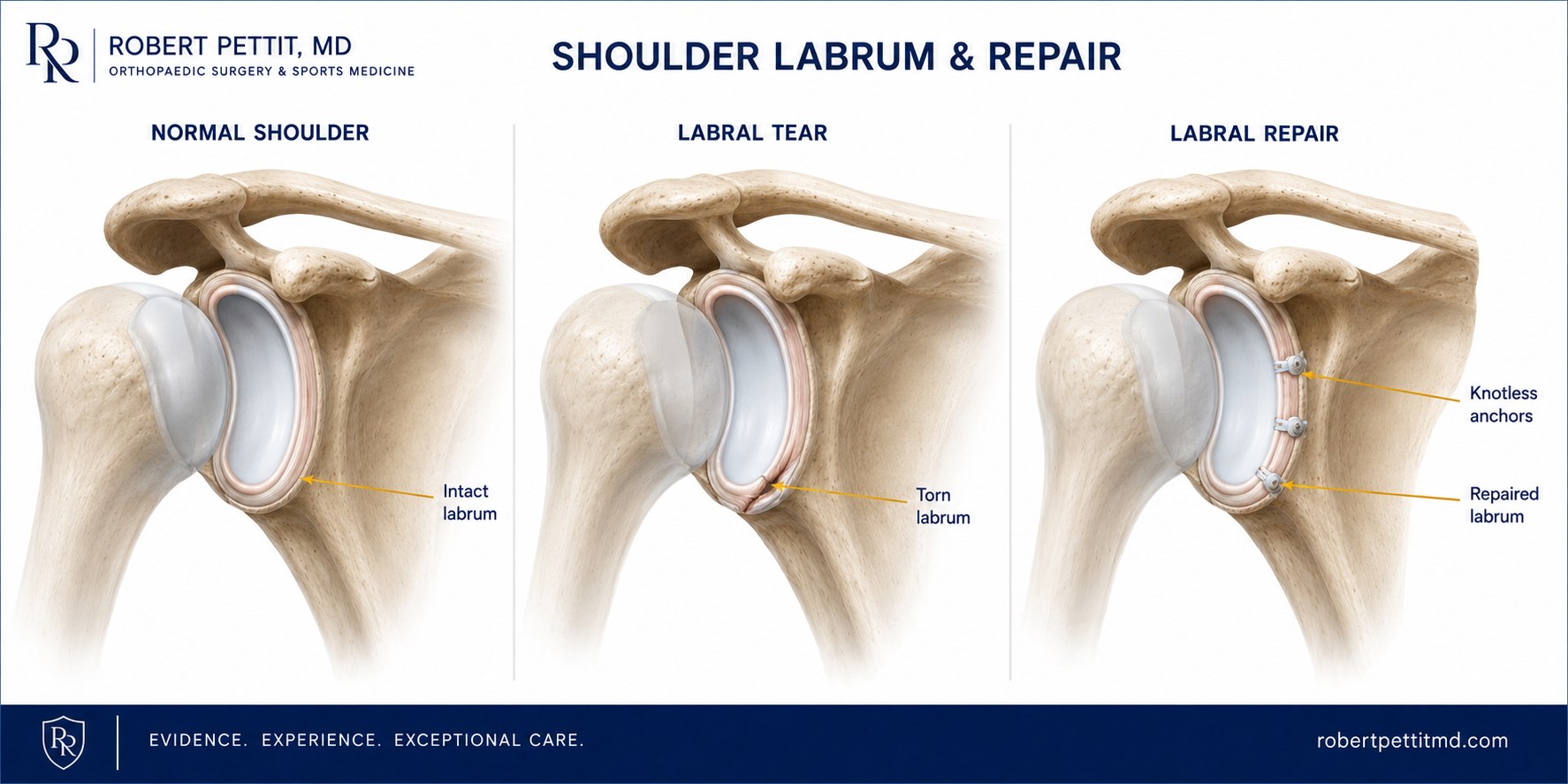
Tap to open the full-size infographic.
How Dr. Pettit approaches arthroscopic labral repair, slap repair and latarjet
Repair matched to the tear
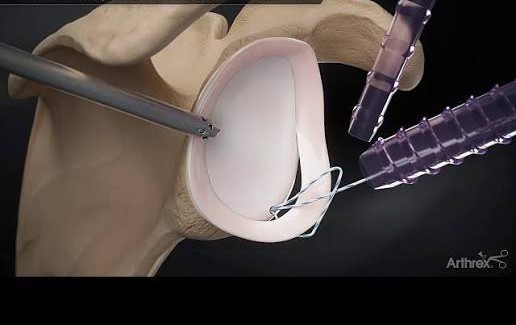
Anterior (Bankart), posterior, and SLAP tears are repaired arthroscopically with knotless suture anchors that restore the labrum's bumper and tighten the capsule. In throwers, a SLAP tear is often better served by a biceps tenodesis than a repair, and Dr. Pettit will explain which applies to you.
Bone loss is measured, not guessed
Recurrent dislocations wear away the socket. When CT shows meaningful bone loss or an engaging Hill-Sachs lesion, a soft-tissue repair alone fails too often. Dr. Pettit performs the Latarjet procedure, transferring a piece of the coracoid with its tendon to rebuild the socket, and treats reverse Hill-Sachs defects with allograft when needed.
Built for athletes
As a team physician for professional, collegiate, and high-school programs, Dr. Pettit plans the procedure and the timeline around your season and your return-to-play criteria.
Pain control built around Journavx, not opioids
Dr. Pettit pairs a nerve block with Journavx (suzetrigine), the first new non-opioid prescription pain medicine in decades, alongside scheduled Tylenol and an anti-inflammatory. Most patients use little or no narcotic medication, which means clearer thinking, less nausea, and an earlier return to normal activity.
What recovery looks like
- Weeks 0–6Sling for six weeks; gentle protected motion with therapy begins early. Driving resumes once the sling comes off.
- Weeks 6–12Active motion and rotator cuff and scapular strengthening.
- Months 3–5Progressive strengthening and sport-specific work; throwing programs begin.
- Months 5–7Return to contact and overhead sport after passing strength and stability testing.
Timelines are typical, not promises. Your written protocol is individualized to what Dr. Pettit finds at surgery.
Go deeper
Patient guide: the condition, treatment options and evidence
Preparing for surgery: medications, day-of instructions
Post-operative protocol and physical therapy plan
Journavx before surgery: the non-opioid pain medicine we prescribe
Labral repair with knotless anchors animation (Orthopedia)
Questions patients ask
Do I need surgery after one dislocation?
Not always. Young athletes in contact or overhead sports have a very high recurrence rate after a first dislocation and are often better off with early repair. Older patients with a first dislocation are usually treated without surgery.
Latarjet or labral repair?
Labral repair when the bone is intact; Latarjet when the socket has lost bone, in high-risk contact athletes, or after a failed repair. A CT scan makes the decision objective.
Is Latarjet an open surgery?
Yes, through a small incision at the front of the shoulder. It has the lowest recurrence rate of any stabilization procedure.
What is a SLAP tear?
A tear of the top of the labrum where the biceps tendon attaches. In throwers and patients over 35 it is often treated with a biceps tenodesis, which relieves pain more reliably than a repair.
When can I throw again?
Most throwers begin an interval throwing program around four months and return to competition at six to nine months, following the return-to-throwing program on this site.
See Dr. Pettit this week
Book directly into Dr. Pettit's schedule, or leave your details and our team will call you within one business day.
Book online now (513) 354-3700Most major insurance plans accepted, including Medicare. Bring any imaging you already have.
- Fort Thomas, KY, 775 Alexandria Pike (Mon & Tue AM, Thu PM)
- Beacon East, Anderson (Tue PM)
- Red Bank, Hyde Park (Thu AM)
- Beacon West, Western Hills (Wed AM)
- Finneytown (Mon PM)