Rotator cuff repair in Cincinnati and Northern Kentucky
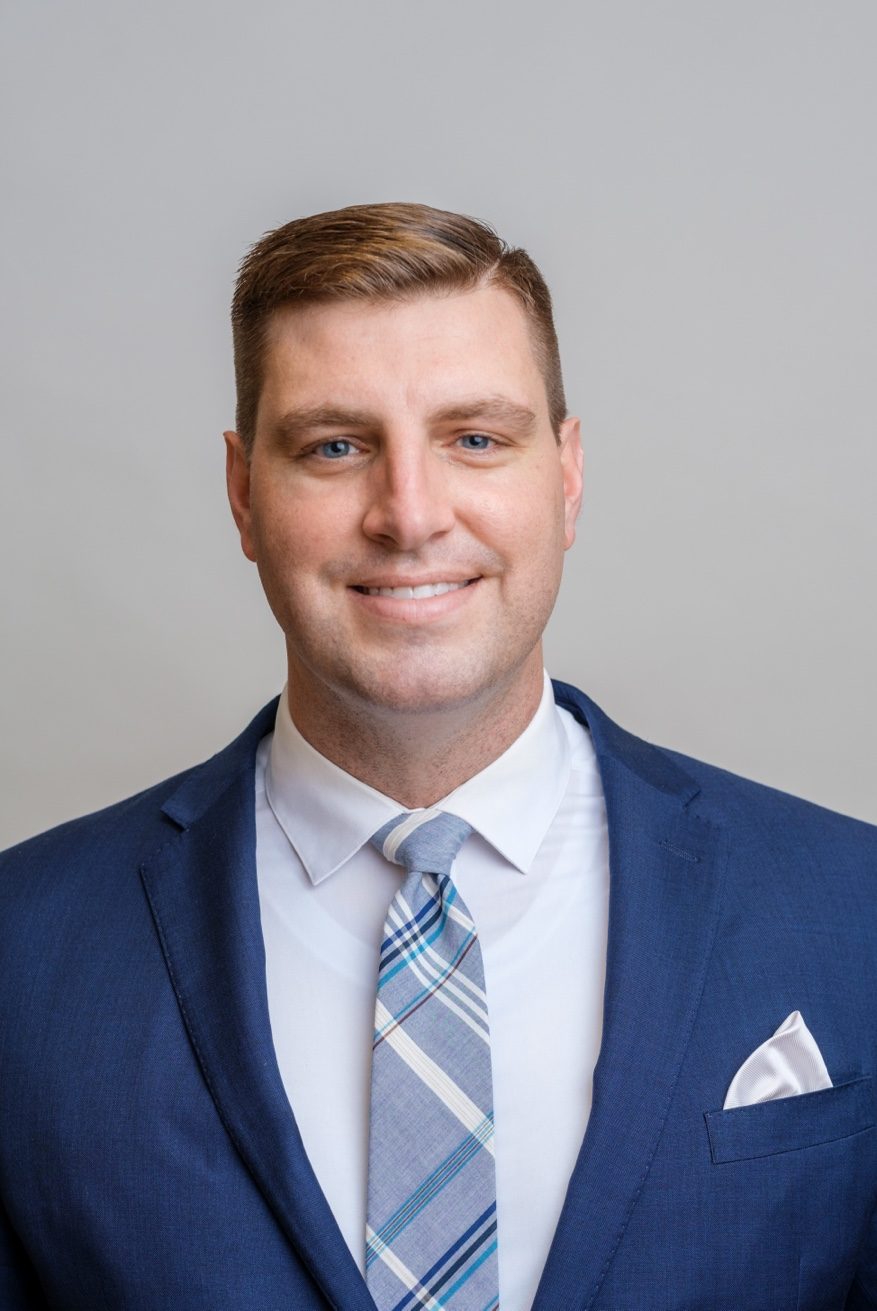
Dr. Robert Pettit repairs rotator cuff tears arthroscopically, through small incisions, and manages the recovery with his physician assistant Maria Dodd from the first visit through return to work and sport.
- Board certified, ABOS
- Sports medicine fellowship, Harvard & Tufts (NEBH)
- Cutting-edge technology, minimally invasive techniques
- Same-week appointments
- 4.9★ · 361 Google reviews
Is this surgery right for you?
- Shoulder pain that wakes you at night, and weakness lifting the arm away from the body or reaching overhead.
- A full-thickness tear on MRI, particularly after an injury or in an active patient.
- Pain or weakness that persists after a fair trial of therapy and an injection.
If you are not sure, that is what the first visit is for. Most conditions are evaluated with an exam and X-rays; Dr. Pettit orders an MRI only when it will change your plan.
At a glance
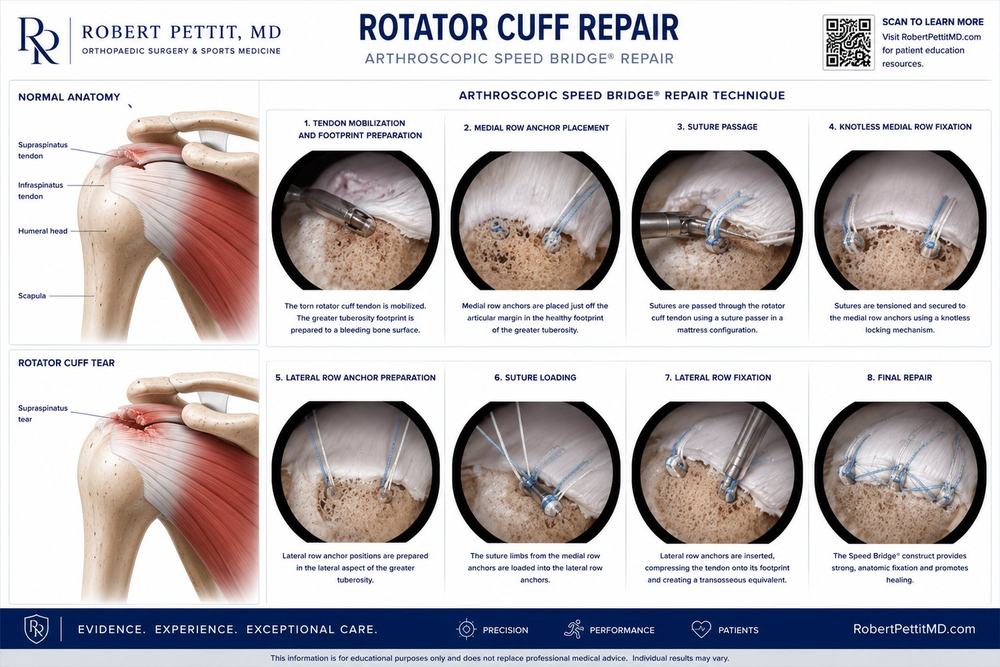
Tap to open the full-size infographic.
How Dr. Pettit approaches arthroscopic rotator cuff repair
Arthroscopic double-row repair
The torn tendon is reattached to bone with suture anchors in a double-row configuration that spreads the load and improves healing. Biceps and bursal problems found at the same time are treated in the same operation.
Tears are matched to the right operation
Partial tears may be debrided or completed and repaired. Massive or long-standing tears may need augmentation, a superior capsular reconstruction, or, when the tendon can no longer be repaired and arthritis has set in, a reverse shoulder replacement. Dr. Pettit has published on both.
Biologics to help the tendon heal
Rotator cuff tendon heals to bone slowly and imperfectly, which is why re-tears happen. For larger tears and older tissue, Dr. Pettit augments the repair with your own biology: platelet-rich plasma (PRP) from your blood, and when indicated bone marrow aspirate concentrate (BMAC), the stem-cell-rich marrow drawn under the same anesthetic, delivered to the repair site at the end of the arthroscopy.
Recovery you can plan around
You will know before surgery how long the sling lasts, when therapy starts, and when you can drive, work, and lift. The same protocol is on this site and goes to your therapist.
Pain control built around Journavx, not opioids
Dr. Pettit pairs a nerve block with Journavx (suzetrigine), the first new non-opioid prescription pain medicine in decades, alongside scheduled Tylenol and an anti-inflammatory. Most patients use little or no narcotic medication, which means clearer thinking, less nausea, and an earlier return to normal activity.
What recovery looks like
- Weeks 0–6Sling for four to six weeks depending on tear size; gentle assisted motion begins with therapy in the first weeks.
- Weeks 6–12Sling comes off, active motion and light strengthening; driving resumes once out of the sling.
- Months 3–5Progressive strengthening; return to most work and daily activity.
- Months 5–8Return to overhead sport and heavy lifting as the repair matures.
Timelines are typical, not promises. Your written protocol is individualized to what Dr. Pettit finds at surgery.
Go deeper
Patient guide: the condition, treatment options and evidence
Preparing for surgery: medications, day-of instructions
Post-operative protocol and physical therapy plan
Journavx before surgery: the non-opioid pain medicine we prescribe
PRP and biologics: Dr. Pettit's guide
Questions patients ask
Does every rotator cuff tear need surgery?
No. Many partial and degenerative tears do well with therapy and an injection. Full-thickness tears in active patients, tears after an injury, and tears with weakness generally do better repaired before the tendon retracts.
How long does the surgery take?
About 60–90 minutes as an outpatient with a nerve block and general anesthesia.
How painful is recovery?
The first week is the hardest. A nerve block, a non-opioid regimen and the medication tracker on this site keep most patients comfortable with little or no narcotic use.
Do PRP or stem cells help a cuff repair?
Evidence suggests biologic augmentation can improve tendon-to-bone healing in higher-risk repairs. Dr. Pettit uses it selectively and will tell you whether it makes sense for your tear.
Can the repair re-tear?
Small and medium tears heal reliably. Larger tears and older tissue carry more risk, which is why Dr. Pettit protects the repair in a sling and progresses therapy on a schedule rather than by feel.
When can I sleep normally?
Most patients sleep propped up for a few weeks and are back to lying flat around six weeks.
See Dr. Pettit this week
Book directly into Dr. Pettit's schedule, or leave your details and our team will call you within one business day.
Book online now (513) 354-3700Most major insurance plans accepted, including Medicare. Bring any imaging you already have.
- Fort Thomas, KY, 775 Alexandria Pike (Mon & Tue AM, Thu PM)
- Beacon East, Anderson (Tue PM)
- Red Bank, Hyde Park (Thu AM)
- Beacon West, Western Hills (Wed AM)
- Finneytown (Mon PM)