What is a rotator cuff tear?
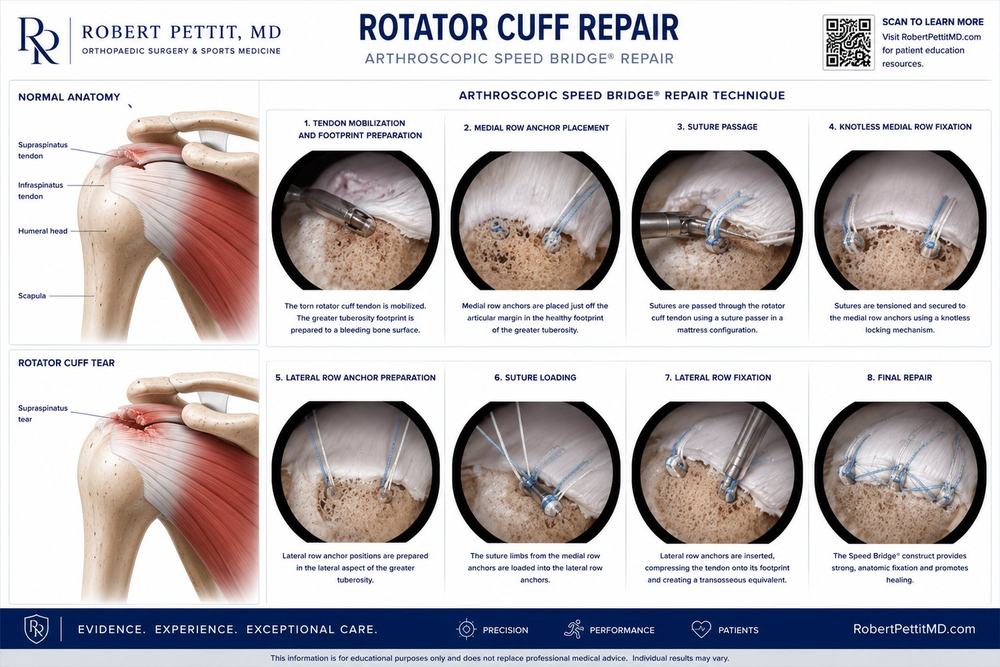
The rotator cuff is a set of four tendons that center the ball in the shoulder socket and power lifting and rotation. Tears range from partial-thickness fraying to full-thickness tears that pull off the bone — some come from a single injury, but many develop gradually with age and use.
Do all tears need surgery?
No. Many partial and degenerative tears improve with physical therapy that restores mechanics and strengthens the surrounding muscles, sometimes with a targeted injection. Full-thickness tears in active patients, acute traumatic tears, and tears that fail conservative care are the ones that benefit most from repair — and repairing them before they enlarge and retract protects your options.
Arthroscopic repair
Dr. Pettit repairs the cuff arthroscopically — through small poke-hole incisions with a camera — reattaching the tendon to bone with suture anchors, most commonly in a double-row construct that compresses the tendon footprint for healing. Biceps problems and bone spurs found at surgery are addressed in the same setting.
Recovery timeline
Tendon-to-bone healing is slow biology, and the protocol respects it: a sling with strict protection for the first two weeks, staged passive motion through week six, active motion from weeks six to twelve, and strengthening only after week twelve. Most patients return to full activity over four to six months depending on tear size.
Pain control after surgery
Frequently asked questions
How do I know if my rotator cuff is torn?
Night pain, pain reaching overhead or behind your back, and weakness are the classic signs. An exam plus MRI confirms the diagnosis and sizes the tear, which drives the treatment recommendation.
How long do I wear the sling after repair?
Strict sling use for the first two weeks, then progressive weaning during the staged-motion phase per your protocol. Protecting the repair early is what lets the tendon heal to bone.
When can I lift weights again?
Resisted cuff strengthening doesn’t begin before 12 weeks, with progressive loading after that. Rushing strengthening is the most common way repairs fail.
What happens if a tear is left alone?
Some tears stay stable, but full-thickness tears can enlarge and retract over time, and long-standing large tears can become irreparable or lead to cuff-tear arthropathy. That’s why active patients with full-thickness tears benefit from earlier evaluation.