Mako partial knee replacement in Cincinnati and Northern Kentucky
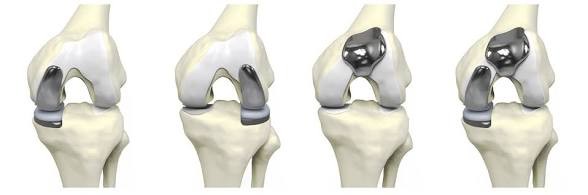
When arthritis is confined to one part of the knee, a partial replacement resurfaces only that compartment and leaves your ligaments and healthy cartilage alone. Dr. Robert Pettit performs it with Mako robotic planning for precise fit and alignment.
- Board certified, ABOS
- Sports medicine fellowship, Harvard & Tufts (NEBH)
- Mako robotics certified
- Same-week appointments
- 4.9★ · 361 Google reviews
Is this surgery right for you?
- Your pain is on one side of the knee, most often the inner (medial) side, and X-rays show bone-on-bone wear limited to that compartment.
- Your ACL is intact and the knee bends and straightens well.
- Injections and activity changes no longer control the pain, and you want to stay active.
If you are not sure, that is what the first visit is for. Most conditions are evaluated with an exam and X-rays; Dr. Pettit orders an MRI only when it will change your plan.
At a glance
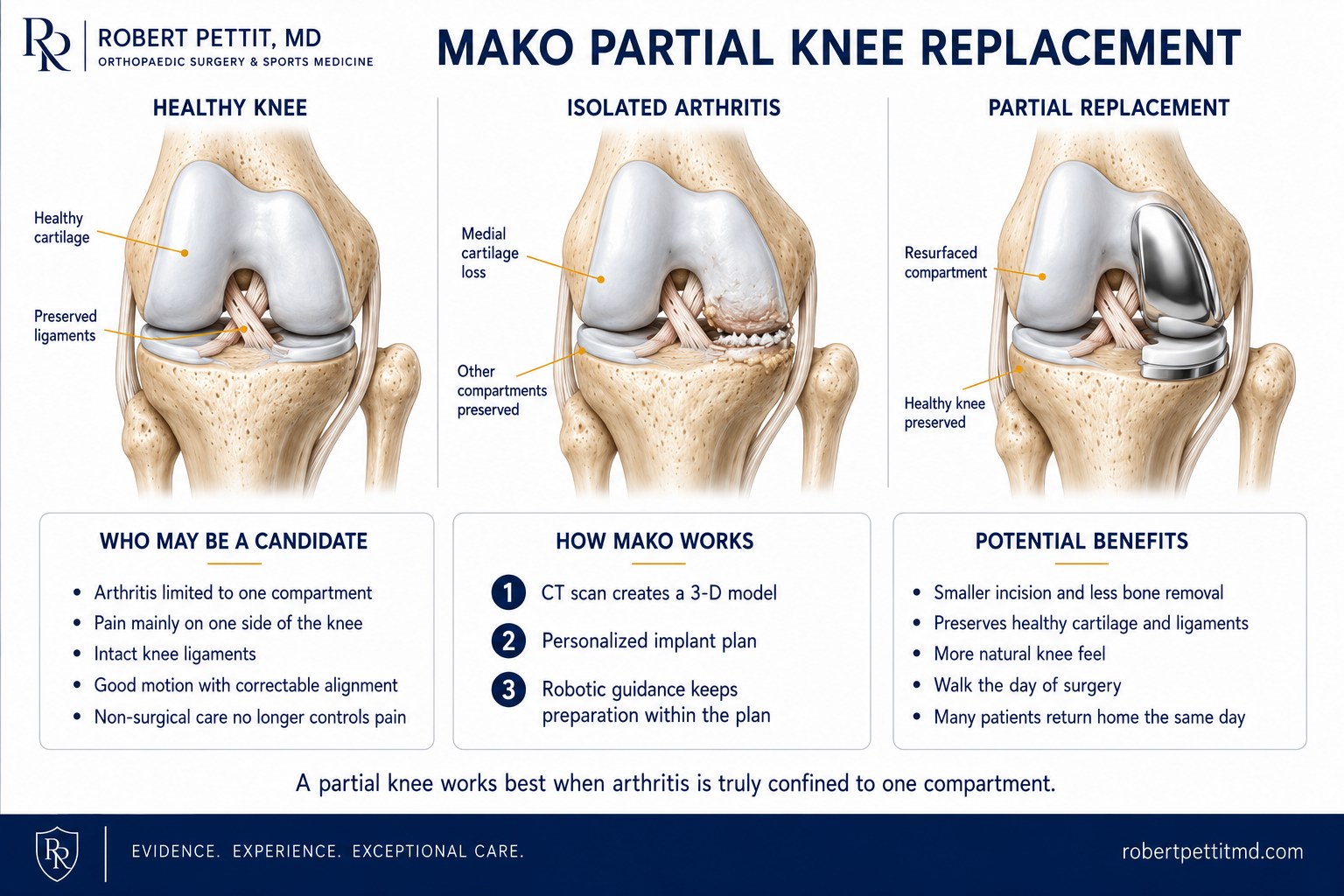
Tap to open the full-size infographic.
How Dr. Pettit approaches mako partial
A CT-based plan before the first incision
A CT scan builds a 3-D model of your knee. Dr. Pettit plans the implant position on that model, then confirms and fine-tunes it in the operating room using the Mako robotic arm, which keeps the cut within the planned boundaries.
Smaller operation, faster recovery
Compared with a total knee, a partial uses a smaller incision, removes less bone, preserves both cruciate ligaments and feels more like a natural knee. Most patients walk the day of surgery and many go home the same day.
Honest selection
A partial knee only works when the rest of the knee is healthy. If Dr. Pettit finds arthritis in more than one compartment, he will recommend a Mako total knee instead, and tells you that before surgery.
Pain control built around Journavx, not opioids
Dr. Pettit pairs a nerve block with Journavx (suzetrigine), the first new non-opioid prescription pain medicine in decades, alongside scheduled Tylenol and an anti-inflammatory. Most patients use little or no narcotic medication, which means clearer thinking, less nausea, and an earlier return to driving.
What recovery looks like
- Day 0–1Walk with a walker or crutches the day of surgery; most patients go home the same day.
- Weeks 1–2Physical therapy for motion and strength; many patients are off a walking aid within two weeks.
- Weeks 2–6Walking normally, driving once off narcotics and able to brake, return to desk work.
- Months 2–4Golf, cycling, doubles tennis, and hiking as strength returns.
Timelines are typical, not promises. Your written protocol is individualized to what Dr. Pettit finds at surgery.
Questions patients ask
Partial or total knee replacement: which do I need?
It depends on how many compartments are worn. Roughly one in four to five arthritic knees is a candidate for a partial. Dr. Pettit decides from your X-rays, exam and, when needed, an MRI.
How long does a partial knee last?
Modern partial knees with robotic alignment have survivorship above 90 percent at ten years in registry data. If arthritis progresses elsewhere in the knee, it can be converted to a total knee.
What does the robot actually do?
The Mako arm does not operate on its own. It holds the cutting instruments within the boundaries of Dr. Pettit's plan so the bone cuts and implant position match the plan to within about a millimetre.
Will I need a hospital stay?
Most partial knees are done as outpatient procedures at a Beacon surgery center or with an overnight stay at Good Samaritan Hospital, depending on your health.
Which insurance is accepted?
Beacon Orthopaedics accepts most major plans including Medicare. Call (513) 354-3700 to confirm yours.
See Dr. Pettit this week
Book directly into Dr. Pettit's schedule, or leave your details and our team will call you within one business day.
Book online now (513) 354-3700Most major insurance plans accepted, including Medicare. Bring any imaging you already have.
- Fort Thomas, KY, 775 Alexandria Pike (Mon & Tue AM, Thu PM)
- Beacon East, Anderson (Tue PM)
- Red Bank, Hyde Park (Thu AM)
- Beacon West, Western Hills (Wed AM)
- Finneytown (Mon PM)