What is a partial knee replacement?
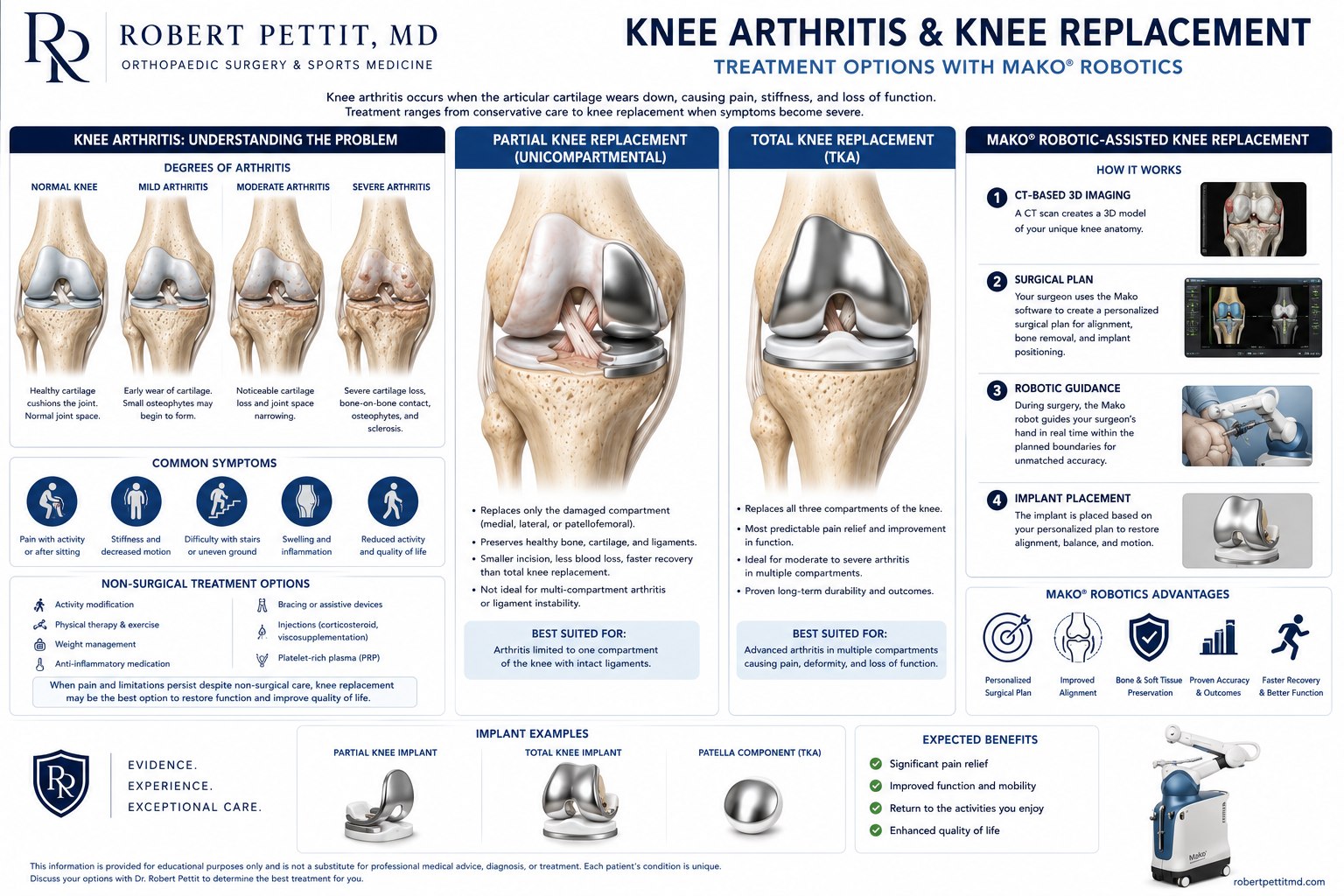
The knee has three compartments — medial (inside), lateral (outside), and patellofemoral (kneecap). When arthritis is limited to one compartment with healthy ligaments, a unicompartmental replacement resurfaces only that compartment with a small implant, leaving the rest of your native knee untouched.
Why patients choose it
Compared with total knee replacement: a smaller incision, less blood loss, faster recovery, and — because your cruciate ligaments are preserved — a knee that feels more like your own. Studies consistently show higher patient-reported “forgotten joint” scores for well-selected partial knees.
The Mako difference for partials
Implant positioning tolerance in partial knee replacement is tight — small errors matter more than in total knees. That’s exactly where robotic execution shines: your CT-based 3D plan is delivered by the robotic arm within fractions of a millimeter, protecting the compartments being preserved.
Candidacy & recovery
The ideal candidate has single-compartment arthritis, intact ligaments, and correctable alignment — Dr. Pettit confirms this with X-rays, exam, and the pre-operative CT. Recovery is brisk: walking day one, many patients off assistive devices in two to three weeks, and return to low-impact sport over two to three months.
Pain control after surgery
Frequently asked questions
Partial vs. total — how do I know which I need?
Imaging and exam decide it. Arthritis limited to one compartment with intact ligaments favors a partial; disease in multiple compartments or deficient ligaments calls for a total. Dr. Pettit shows you your images and explains the recommendation.
Will I still need a total knee later?
A well-done partial in a well-selected patient can last 10–15+ years. If arthritis later progresses in other compartments, conversion to a total knee remains straightforward.
Is recovery really faster?
Yes — most patients are weeks ahead of the total-knee timeline at every milestone: walking unassisted, driving, and returning to activity.