Mako robotic total knee replacement in Cincinnati and Northern Kentucky
Dr. Robert Pettit is a Mako-certified, board-certified orthopaedic surgeon who performs robotic-arm assisted total knee replacement for patients whose arthritis has outgrown injections and joint preservation.
- Board certified, ABOS
- Sports medicine fellowship, Harvard & Tufts (NEBH)
- Mako robotics certified
- Same-week appointments
- 4.9★ · 361 Google reviews
Is this surgery right for you?
- X-rays show bone-on-bone arthritis in more than one part of the knee.
- Pain limits walking, stairs, and sleep despite injections, therapy, and activity changes.
- You are ready to commit to the rehabilitation that makes a new knee work well.
If you are not sure, that is what the first visit is for. Most conditions are evaluated with an exam and X-rays; Dr. Pettit orders an MRI only when it will change your plan.
At a glance
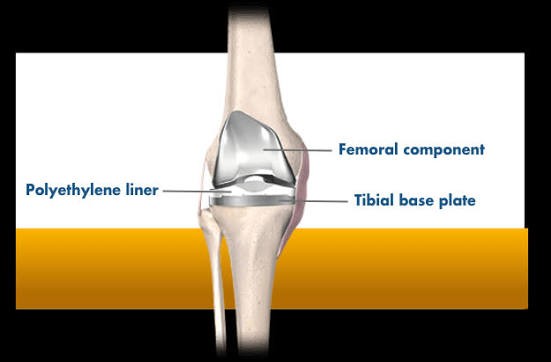
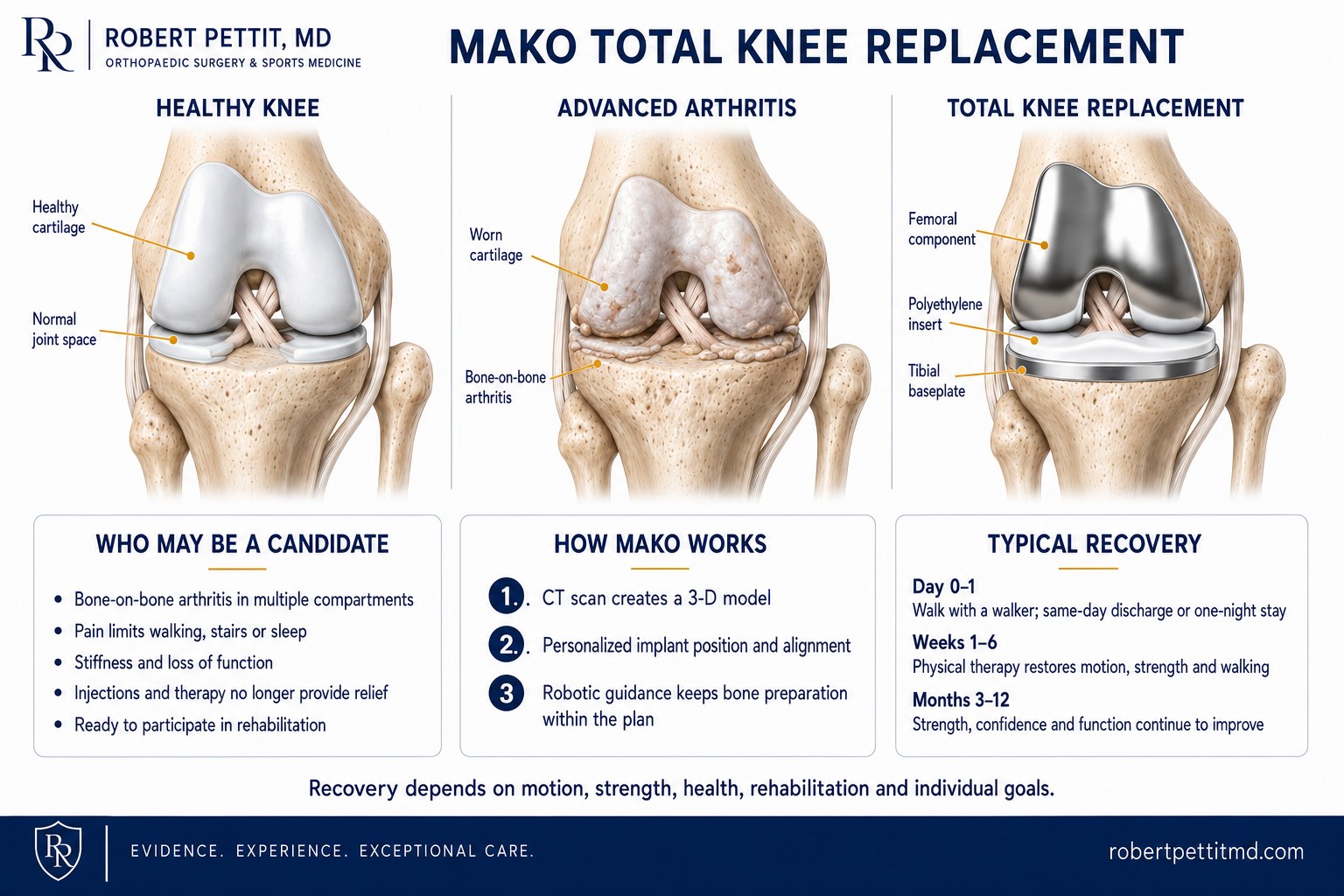
Tap to open the full-size infographic.
How Dr. Pettit approaches mako robotic total knee replacement
Planned on your CT, executed with the robotic arm
A pre-operative CT creates a 3-D model of your knee. Implant size, position, and alignment are planned to your anatomy, and the Mako arm keeps every bone cut inside that plan. The result is a more consistent fit and balance than manual instruments.
Balanced for how you move
During surgery the knee is balanced through its full range of motion before the final implants are placed, adjusting the plan by degrees rather than guessing. Well-balanced knees feel more natural and are less likely to feel loose or stiff.
Muscle-sparing subvastus approach available
Where the anatomy allows, Dr. Pettit reaches the knee beneath the quadriceps rather than cutting through the tendon. Sparing the muscle means a stronger leg from day one, earlier stair climbing, and less pain in the first weeks.
Opioid-sparing protocol
A nerve block at surgery, then Journavx (suzetrigine), scheduled Tylenol, and Celebrex, with a small narcotic supply for breakthrough pain only. Most patients need few or no narcotic tablets, and recover with less nausea, constipation, and grogginess.
Joint preservation is considered first
Dr. Pettit's special interest is avoiding replacement in younger patients. If an osteotomy, cartilage procedure, or partial knee is a genuine option, he will tell you.
What recovery looks like
- Day 0–1Walk with a walker the day of surgery. Same-day discharge or a one-night stay depending on your health.
- Weeks 1–2Physical therapy three times a week for motion; the target is full extension early.
- Weeks 2–6Walker to cane to nothing; driving once off narcotics and able to brake; return to desk work.
- Months 3–12Steady gains in strength and confidence; most patients are back to golf, cycling, and travel by three months.
Timelines are typical, not promises. Your written protocol is individualized to what Dr. Pettit finds at surgery.
Go deeper
Patient guide: the condition, treatment options and evidence
Preparing for surgery: medications, day-of instructions
Post-operative protocol and physical therapy plan
Journavx before surgery: the non-opioid pain medicine we prescribe
“I have never had such a kind and caring doctor. He knew I was nervous about surgery and was there to reassure me beforehand. My knee feels better than it has in years.”
Verified patient, knee replacement
Questions patients ask
Is robotic knee replacement better?
Robotic assistance improves the accuracy of bone cuts and implant alignment and reduces variability. Early outcome studies show less early pain and faster recovery; long-term survival data are still maturing. Dr. Pettit uses Mako for every total knee.
How long will I be in the hospital?
Many patients go home the same day; others stay one night. This is decided with you before surgery based on your health and support at home.
How long does a knee replacement last?
Modern implants last 20 years or more in most patients. Weight, activity, and alignment all matter, which is one reason accurate robotic alignment is valuable.
Will I be able to kneel?
Most patients can kneel, though it may feel odd. Kneeling does not damage the implant.
Where is surgery performed?
Good Samaritan Hospital (TriHealth) or a Beacon surgery center, depending on your health and insurance.
See Dr. Pettit this week
Book directly into Dr. Pettit's schedule, or leave your details and our team will call you within one business day.
Book online now (513) 354-3700Most major insurance plans accepted, including Medicare. Bring any imaging you already have.
- Fort Thomas, KY, 775 Alexandria Pike (Mon & Tue AM, Thu PM)
- Beacon East, Anderson (Tue PM)
- Red Bank, Hyde Park (Thu AM)
- Beacon West, Western Hills (Wed AM)
- Finneytown (Mon PM)