When is it time for a knee replacement?
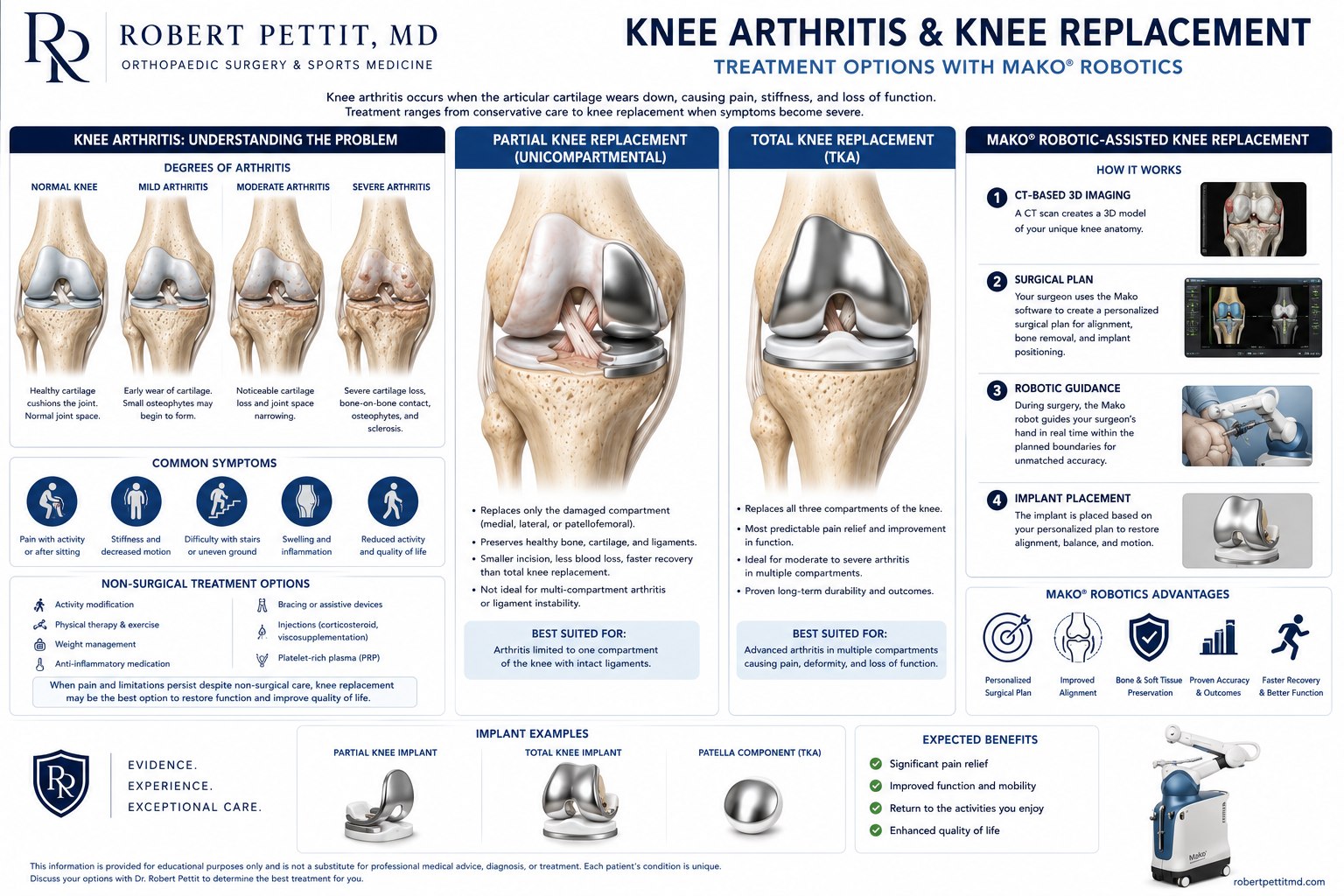
Knee arthritis is a progressive wearing of the joint cartilage. When pain limits walking, stairs, sleep, and the activities you love despite medications, therapy, bracing, and injections, replacement becomes the reliable way to eliminate the arthritic surfaces and correct alignment.
What makes Mako robotic replacement different?
Before surgery, a CT scan builds a 3D model of your knee, and Dr. Pettit plans the implant position, alignment, and soft-tissue balance on that model. In the operating room, the Mako robotic arm guides execution within the planned boundaries — protecting healthy bone and soft tissue and delivering the plan with a precision that’s difficult to match by hand. Every total and partial knee Dr. Pettit performs is planned this way, which is why a pre-operative CT scan is part of your workup.
Total vs. partial replacement
If arthritis is confined to a single compartment with intact ligaments, a Mako partial knee replacement resurfaces only the damaged compartment — smaller incision, faster recovery, more natural feel. Multi-compartment arthritis is best served by total knee replacement. Dr. Pettit reviews your X-rays and CT with you and recommends the option that fits your disease pattern.
Recovery
You’ll be up walking with support the day of surgery, with a rapid-recovery protocol emphasizing early motion, swelling control, and progressive strengthening. Most patients transition from walker to cane over the first weeks, drive around weeks three to four (right knee) once off narcotics, and return to low-impact activities — walking, cycling, golf, doubles tennis — over the following months.
A muscle-sparing approach, guided by robotics
How the knee is exposed matters as much as the implant itself. Dr. Pettit uses a muscle-sparing approach — working around the quadriceps rather than splitting through healthy muscle and tendon — combined with Mako robotic guidance. Preserving the quadriceps means less immediate post-operative pain and less reliance on narcotics, a faster return of your straight-leg raise and quad function, and a quicker transition home — most patients go home the same day. The robotic plan, built from a CT scan of your knee, lets the implant be positioned precisely through that smaller, muscle-respecting exposure without compromising alignment.
Pain control after surgery
Frequently asked questions
How long does a knee replacement last?
Modern implants commonly last 15–20+ years. Robotic planning aims to optimize alignment and balance — factors associated with implant longevity and a natural-feeling knee.
Why do I need a CT scan before surgery?
The CT scan is what powers the Mako plan — it creates the 3D model of your unique anatomy used to position your implant before the first incision is ever made. It’s a required part of scheduling robotic knee replacement with Dr. Pettit.
How painful is recovery?
A multimodal pain program — regional blocks, scheduled non-opioid medications, ice and elevation — keeps most patients ahead of pain, with opioids weaned quickly. Early motion actually reduces pain over the first weeks.
Am I too young (or too old) for a knee replacement?
Age matters less than disability and disease severity. Younger patients with single-compartment disease may be partial-knee or osteotomy candidates; healthy older patients do well with replacement. The decision is individualized.