Meniscus Root Tears & Repair
What Is It?
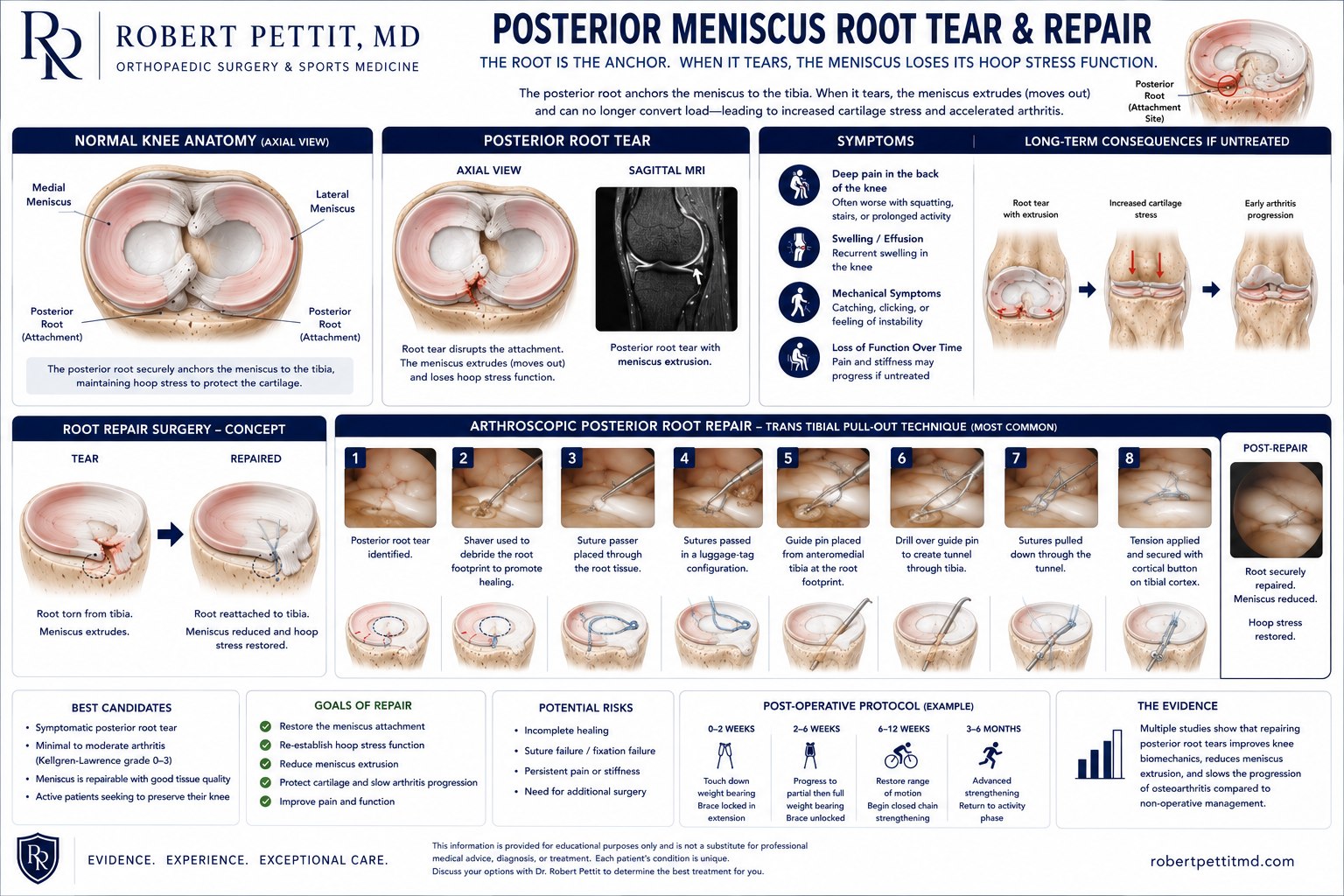
The meniscus root is the short, strong attachment that anchors each end of the meniscus to the tibia. A root tear pulls that anchor loose. Because the ring of the meniscus can no longer hold tension, it stops spreading load across the joint — functionally, the knee behaves as if that meniscus were missing, and cartilage wear can accelerate quickly.
The posterior medial root is the one most often injured. It usually gives way during an everyday movement — a deep squat, kneeling, or a twist — rather than a high-energy sports injury, and is most common in adults over 40.
What It Feels Like
Many patients describe a distinct pop in the back or inner side of the knee, followed within hours by swelling. Pain is felt deep along the joint line, is worse with squatting, stairs and getting up from a chair, and the knee may feel unstable or "give" with pivoting. Symptoms that arrive suddenly in a knee that was previously fine are a clue that the root, not just the body of the meniscus, is involved.
How It Is Diagnosed
Dr. Pettit combines a focused knee exam with an MRI. On MRI a root tear shows characteristic signs — the "ghost" of a missing meniscus on one image slice and the meniscus pushed out from under the bone (extrusion). Standing X-rays show how much cartilage space remains and whether the leg's alignment is contributing; both change the treatment plan.
Treatment
Root repair. When the cartilage is still healthy and alignment is reasonable, Dr. Pettit re-anchors the meniscus arthroscopically: sutures are passed through the torn root, drawn into a small tunnel in the tibia, and secured with a cortical button on the front of the shin. Restoring the anchor restores the meniscus's ability to protect the joint.
Non-surgical care. For lower-demand patients, or when arthritis is already advanced, repair may not change the outcome. Activity modification, strengthening, injections and bracing are used instead, and a partial or total knee replacement is discussed if pain becomes limiting.
After surgery, pain control is built around Journavx (suzetrigine), a non-opioid pain medicine, with a nerve block, scheduled Tylenol and an anti-inflammatory — most patients use little or no narcotic medication.
How Long Recovery Takes
Weeks 0–6: a brace and crutches with limited weight-bearing so the repair can heal to bone; motion exercises begin right away. Weeks 6–12: weaning off crutches, progressive strengthening and cycling. Months 3–6: jogging and low-impact sport. Months 6–9: return to cutting and pivoting once strength and swelling allow. Deep squatting is avoided for the first four months.
Returning to Sport
Return is earned by milestones rather than the calendar: full motion, no swelling, and quadriceps and hop-test strength within 90% of the other leg. Most recreational athletes are back to full activity between six and nine months.
Frequently Asked Questions
Why is a root tear treated differently from an ordinary meniscus tear? The root is the anchor that lets the meniscus work at all. Trimming a root tear the way a flap tear is trimmed leaves the meniscus unloaded; repairing it is the only way to restore its function.
Will I need to stay off the leg? Yes — protected weight-bearing for about six weeks is the main difference between root repair and other meniscus surgery, and it is what protects the healing anchor.
What if it is not repaired? An untreated complete root tear commonly leads to rapid cartilage loss in that compartment; many patients progress to arthritis within a few years.
Learn More
Read how Dr. Pettit approaches meniscus surgery, the meniscus tear patient guide, and the Preparing for Your Meniscus Root Repair packet.
When to Call Us
Call the office at (513) 354-3700 for a knee that locks and will not release, rapidly increasing swelling, calf pain or swelling, fever over 101°F, or pain that is not controlled with medicine.
