Meniscus tear surgery in Cincinnati and Northern Kentucky
Your meniscus is the shock absorber of your knee. Dr. Robert Pettit, a fellowship-trained sports medicine surgeon, saves it whenever it can be saved, using cutting-edge, minimally invasive arthroscopic techniques to repair the tear, or to trim only what cannot heal.
- Board certified, ABOS
- Sports medicine fellowship, Harvard & Tufts (NEBH)
- Cutting-edge technology, minimally invasive techniques
- Same-week appointments
- 4.9★ · 361 Google reviews
Is this surgery right for you?
- Your knee catches, locks, or gives way, or you cannot straighten it all the way.
- Pain along the joint line when you twist, squat, or climb stairs has not settled after a few weeks of rest and therapy.
- Your MRI shows a displaced, unstable, or root tear, or a tear alongside an ACL injury.
If you are not sure, that is what the first visit is for. Most conditions are evaluated with an exam and X-rays; Dr. Pettit orders an MRI only when it will change your plan.
At a glance
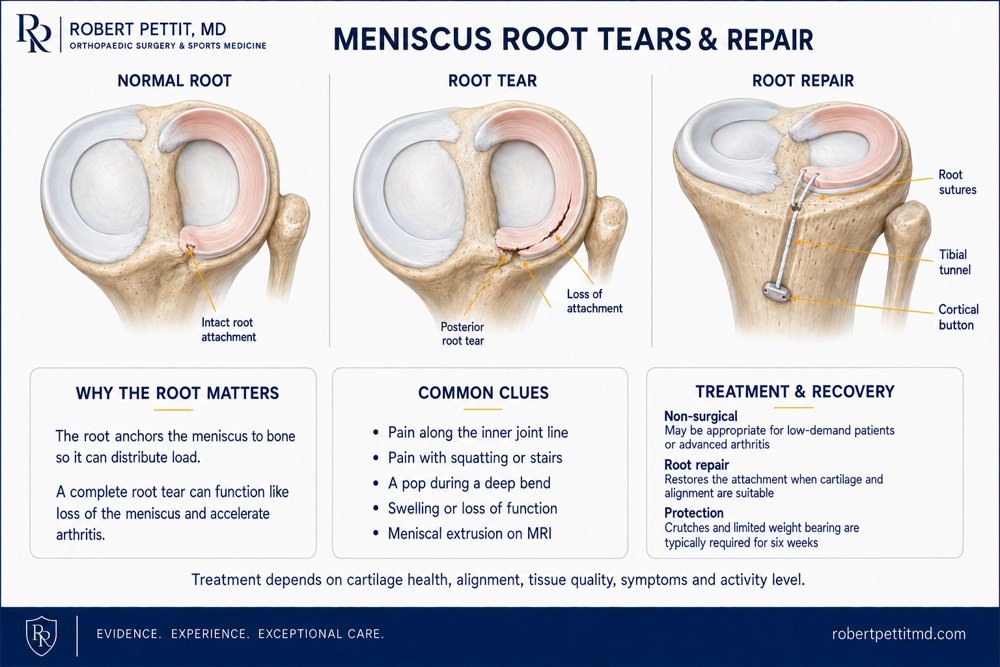
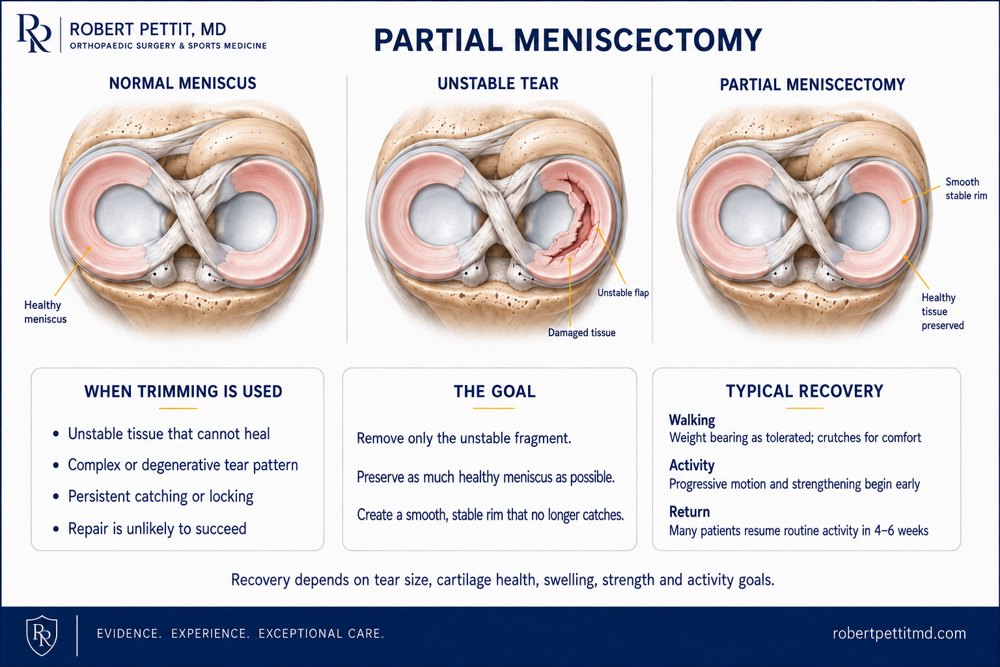
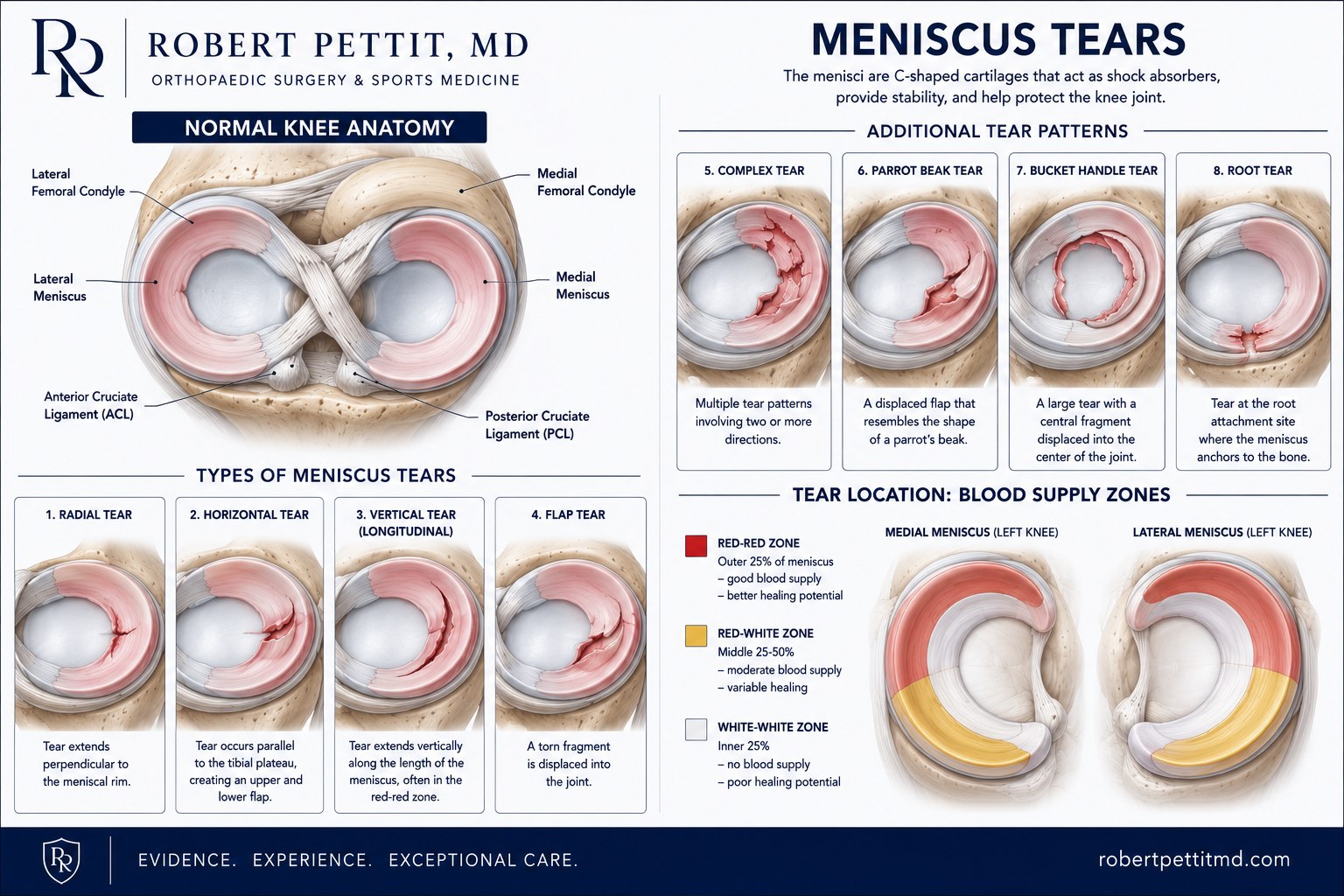
Tap to open the full-size infographic.
How Dr. Pettit approaches meniscus repair and partial meniscectomy
Save the meniscus first
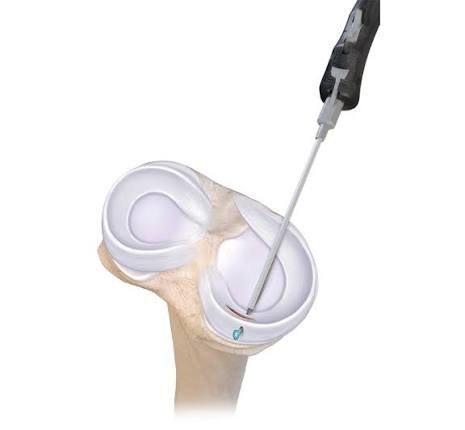
A meniscus that is removed never grows back, and a knee without one wears out early. Vertical, bucket-handle, and root tears in healthy tissue are repaired with all-inside sutures and anchors through two small incisions. Degenerative tears that cannot heal are trimmed to a smooth, stable rim, taking as little tissue as possible.
Root tears get a real repair
A torn meniscus root works like no meniscus at all and leads to arthritis fast. Dr. Pettit re-anchors the root to bone through a small tunnel in the tibia so the meniscus can carry load again.
Biologics to help the repair heal
The meniscus has a poor blood supply, so Dr. Pettit augments repairs with your own biology when it improves the odds of healing: platelet-rich plasma (PRP) drawn from your blood, and bone marrow aspirate concentrate (BMAC), the stem-cell-rich marrow taken from your pelvis during the same anesthetic. Both are delivered to the repair site at the end of the arthroscopy.
Athletes and active adults
As a team physician for professional, collegiate, and high-school programs, Dr. Pettit plans the operation and the rehab around your sport, your season, and your goals.
Pain control built around Journavx, not opioids
Dr. Pettit pairs a nerve block with Journavx (suzetrigine), the first new non-opioid prescription pain medicine in decades, alongside scheduled Tylenol and an anti-inflammatory. Most patients use little or no narcotic medication, which means clearer thinking, less nausea, and an earlier return to normal activity.
What recovery looks like
- Week 1Crutches and, after a repair, a brace. Motion and quad exercises start the day after surgery.
- Weeks 1–6After a partial meniscectomy, walking without crutches within days. After a repair, weight bearing depends on the tear: most repairs walk in the brace from the start; root and radial repairs stay off the leg for six weeks.
- Weeks 6–12Strengthening and return to daily activity. Deep squatting is held off after a repair until about three months.
- Months 3–6Return to running and sport after a repair; usually 4–8 weeks after a meniscectomy.
Timelines are typical, not promises. Your written protocol is individualized to what Dr. Pettit finds at surgery.
Go deeper
Patient guide: the condition, treatment options and evidence
Preparing for surgery: medications, day-of instructions
Post-operative protocol and physical therapy plan
Journavx before surgery: the non-opioid pain medicine we prescribe
PRP and biologics: Dr. Pettit's guide
All-inside meniscus repair animation (Orthopedia)
Questions patients ask
Will my meniscus tear heal on its own?
Small tears at the outer edge have a blood supply and can settle with rest and therapy. Tears in the inner two-thirds, displaced tears, and root tears do not heal without surgery.
Repair or trim: how do you decide?
By the tear pattern, location, tissue quality, and your age. Dr. Pettit tells you the likely plan before surgery and confirms it when he sees the tear through the arthroscope.
How long does the surgery take?
About 30 minutes for a partial meniscectomy and 45–60 minutes for a repair. Both are outpatient procedures with a nerve block and general anesthesia.
Will I need physical therapy?
Yes after a repair or root repair. After a simple meniscectomy most patients do well with the home exercise program on this site.
Do PRP or stem cells really help?
Evidence suggests biologic augmentation improves healing rates for repairs at higher risk of failing, such as tears in the inner zone or in older tissue. It is an add-on to a well-done repair, not a substitute for one, and Dr. Pettit will tell you whether it is worth it in your case.
What if I also have arthritis?
Dr. Pettit will tell you plainly whether surgery is likely to help. When arthritis is the real source of pain, injections, activity changes, or joint preservation may be the better path.
See Dr. Pettit this week
Book directly into Dr. Pettit's schedule, or leave your details and our team will call you within one business day.
Book online now (513) 354-3700Most major insurance plans accepted, including Medicare. Bring any imaging you already have.
- Fort Thomas, KY, 775 Alexandria Pike (Mon & Tue AM, Thu PM)
- Beacon East, Anderson (Tue PM)
- Red Bank, Hyde Park (Thu AM)
- Beacon West, Western Hills (Wed AM)
- Finneytown (Mon PM)