What’s actually wrong in there
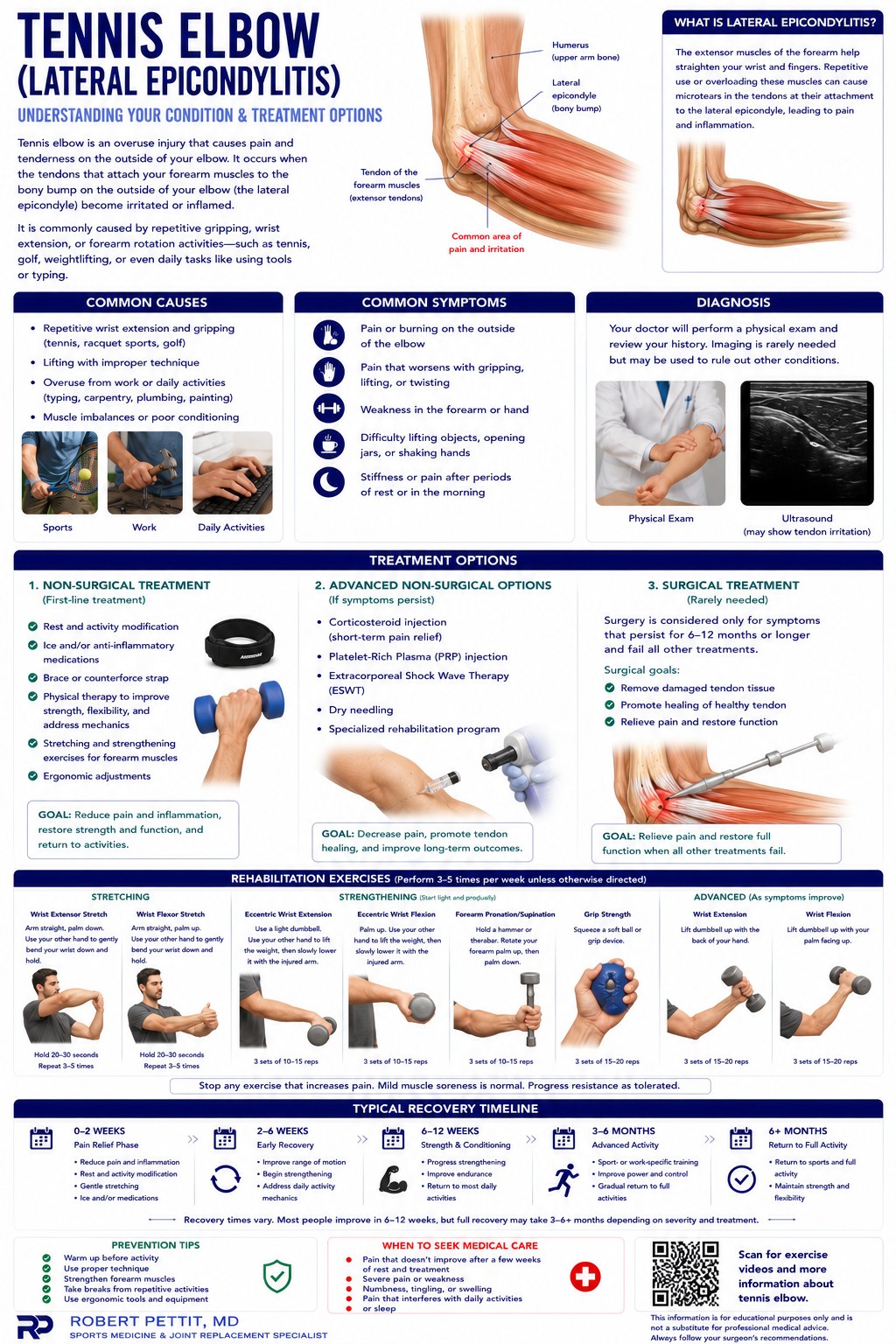
Despite the “itis” name, these are tendinoses — degenerative wear where the forearm tendons anchor to the elbow’s bony bumps. Tennis elbow affects the extensor origin on the outside (lateral epicondyle); golfer’s elbow affects the flexor-pronator origin on the inside. Most cases come from repetitive gripping and wrist work — keyboards, tools, and lifting cause far more cases than racquets.
The treatment that works: loading, not resting
Tendons rebuild under slow, controlled load. The core of treatment is an eccentric strengthening program — slowly lowering against resistance — along with stretching, activity modification, and a counterforce brace that unloads the tendon origin during activity. Dr. Pettit’s complete elbow program, with FlexBar Tyler Twists for both conditions, is free on this site.
When conservative care stalls
For cases that persist beyond several months of a well-done program, PRP injection has the strongest biologic evidence of any tendinopathy — concentrating your own growth factors at the degenerated origin. Cortisone can rescue an acute flare but repeated doses undermine the tendon and are used sparingly.
Surgery — rarely needed, very effective when it is
The small minority of cases that fail 6–12 months of full-spectrum conservative care are candidates for a minor procedure that debrides the degenerated tendon tissue and stimulates healing. Recovery runs a few months, with excellent success rates in properly selected patients.
Frequently asked questions
How long does tennis elbow take to heal?
With a consistent loading program, most patients improve meaningfully over 6–12 weeks, though full recovery of chronic cases takes months. The program works — the failure mode is abandoning it early.
Should I wear a brace?
A counterforce strap worn just below the elbow during aggravating activity reduces strain on the tendon origin. Wear it for activity, not around the clock.
Does PRP work for tennis elbow?
Tennis elbow has the best PRP evidence of any condition — meaningful and durable improvement in the majority of chronic cases that failed other care.
When should I see a doctor about elbow pain?
If pain persists beyond a few weeks despite backing off aggravating activity, is waking you at night, or is accompanied by weakness or numbness, get evaluated — other conditions like nerve entrapment and elbow instability can masquerade as epicondylitis.