What are SLAP tears and biceps tendinitis?
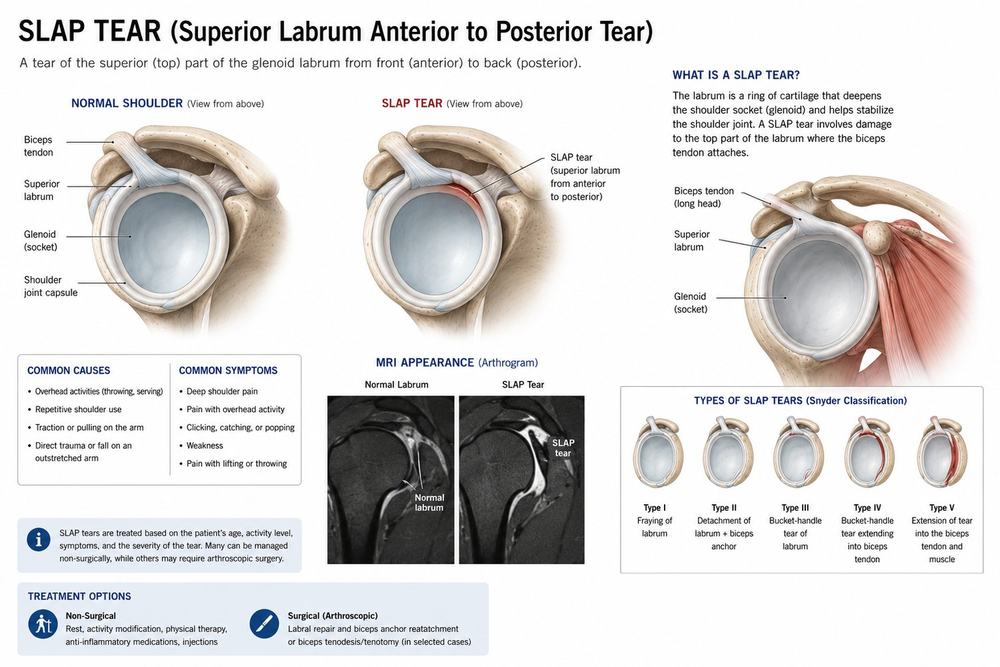
The labrum is the cartilage rim that deepens the shoulder socket, and its top (superior) portion is where the long head of the biceps tendon anchors. A SLAP tear (Superior Labrum Anterior to Posterior) disrupts this biceps anchor — common in overhead and throwing athletes, after a fall on an outstretched arm, or with age. Biceps tendinitis is inflammation of the same tendon where it travels through a narrow groove at the front of the shoulder — and the two frequently occur together, often alongside rotator cuff problems.
Typical symptoms: deep shoulder pain with overhead or throwing motions, catching or popping, pain at the front of the shoulder radiating down the arm, and loss of throwing velocity — the classic 'dead arm.'
How are they diagnosed?
Dr. Pettit uses specific provocative tests (such as the O'Brien active-compression test) along with your history. Because the labrum is hard to see on plain images, MRI — often with contrast dye injected into the joint (MR arthrogram) — is the best test to confirm a SLAP tear. Ultrasound or MRI can confirm biceps tendon inflammation and identify associated rotator cuff or labral pathology.
Treatment options
Most cases improve without surgery: physical therapy focused on the rotator cuff and shoulder-blade mechanics, activity modification, anti-inflammatory measures, and sometimes a targeted injection. When symptoms persist, the two main surgical options are:
- SLAP repair — arthroscopically reattaching the torn labrum, generally favored in younger overhead athletes.
- Biceps tenodesis — detaching the biceps tendon from its irritated anchor inside the joint and securing it to the humerus outside the joint. This relieves pain while preserving biceps strength and contour (avoiding the 'Popeye' deformity of a simple release), and is often preferred over repair for many tear patterns and in patients beyond their throwing years.
The choice is individualized by age, sport, and tear pattern — and either can be combined with rotator cuff or labral surgery when needed.
Recovery timeline
Non-surgical care typically improves symptoms gradually over 4–8 weeks of therapy. After tenodesis: a sling with restricted active biceps use for the first 6 weeks (no resisted elbow bending or lifting while the fixation heals), active motion progression weeks 6–12, strengthening months 3–4, and return to full activity by months 4–6. Return to overhead sport after SLAP surgery is typically around 4–6 months, guided by strength and function.
Pain control after surgery
Frequently asked questions
Do all SLAP tears need surgery?
No — many improve with physical therapy focused on rotator cuff strength and shoulder-blade mechanics. Surgery is for persistent symptoms after quality rehab.
SLAP repair or biceps tenodesis — which would I get?
It depends on your age, sport, and tear pattern. Repair is generally favored in younger overhead athletes; tenodesis is often more reliable for pain relief in other patients and avoids repair-related stiffness.
Will my biceps look different after tenodesis?
Tenodesis is specifically designed to preserve normal muscle contour and strength — unlike simply releasing the tendon, which can cause a 'Popeye' bulge.
How long until I can lift with that arm again?
Resisted lifting and elbow bending are typically restricted for about 6 weeks after tenodesis to protect the fixation while it heals, then progressed through therapy.