What is an ACL tear?
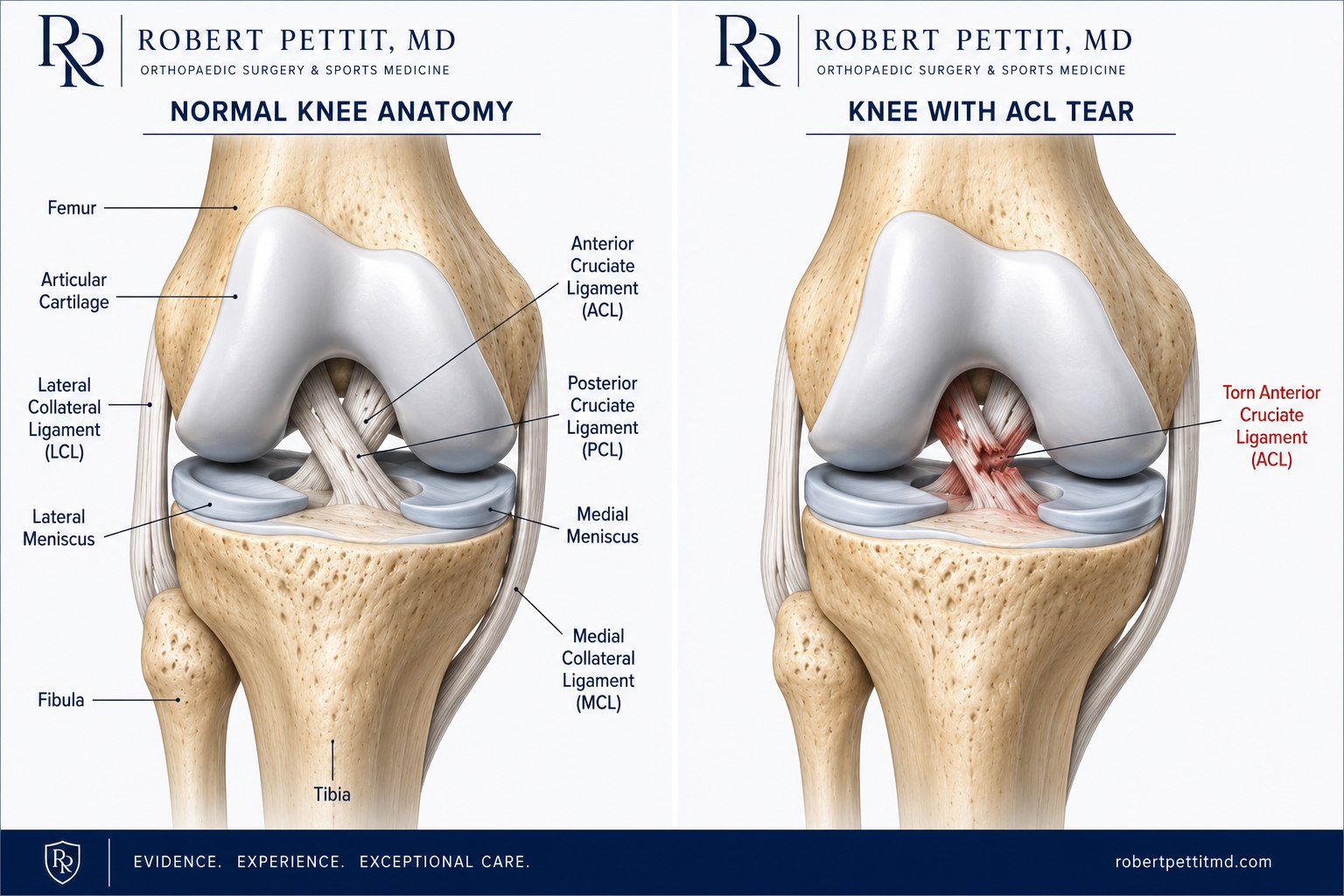
The anterior cruciate ligament (ACL) is the primary stabilizer that keeps your shin bone from sliding forward under your thigh bone during cutting and pivoting. Most tears happen in non-contact moments — a plant-and-twist, an awkward landing, a sudden stop. You may hear a pop, feel the knee give way, and develop swelling within hours.
How is it diagnosed?
Dr. Pettit combines a focused knee exam (Lachman and pivot-shift testing) with MRI to confirm the tear and to look for associated injuries — meniscus tears, cartilage damage, and collateral ligament injuries occur alongside many ACL tears and change the surgical plan.
Treatment options
Not every ACL tear needs surgery — lower-demand patients who don’t cut or pivot can do well with structured rehabilitation. For athletes and active patients, ACL reconstruction replaces the torn ligament with a graft. Dr. Pettit individualizes the graft choice — bone-patellar tendon-bone, quadriceps tendon, or allograft — based on your age, sport, and anatomy, and addresses any meniscus or cartilage injury at the same surgery.
Recovery & return to sport
Recovery follows a criterion-based progression over 9–12 months: early motion and quad activation, progressive strengthening, running when strength testing allows, and a return-to-sport phase gated by objective criteria — quadriceps and hop-test symmetry of at least 90% and psychological readiness. Returning before 9 months is associated with significantly higher re-injury rates, so milestones are earned, not scheduled.
Pain control after surgery
Frequently asked questions
Do I need surgery for a torn ACL?
Not always. If you don’t participate in cutting or pivoting activities, structured physical therapy can restore stable function. Athletes and active patients who want to return to sports that involve cutting, jumping, or pivoting are usually best served by reconstruction.
How long until I can play sports again?
Dr. Pettit’s protocol targets return to sport no earlier than 9 months, and only once strength and hop testing reach at least 90% of your uninjured leg. This criterion-based approach is what protects the new graft.
What graft is best?
There is no single best graft — bone-patellar tendon-bone and quadriceps tendon autografts are workhorses for young athletes, while allograft may fit lower-demand patients. Dr. Pettit walks through the trade-offs and matches the graft to you.
Can I walk after ACL surgery?
Yes — you’ll bear weight as tolerated with crutches from day one, with a brace protecting the knee early on. Most patients wean crutches within the first few weeks as quad control returns.