What happened to your tendon
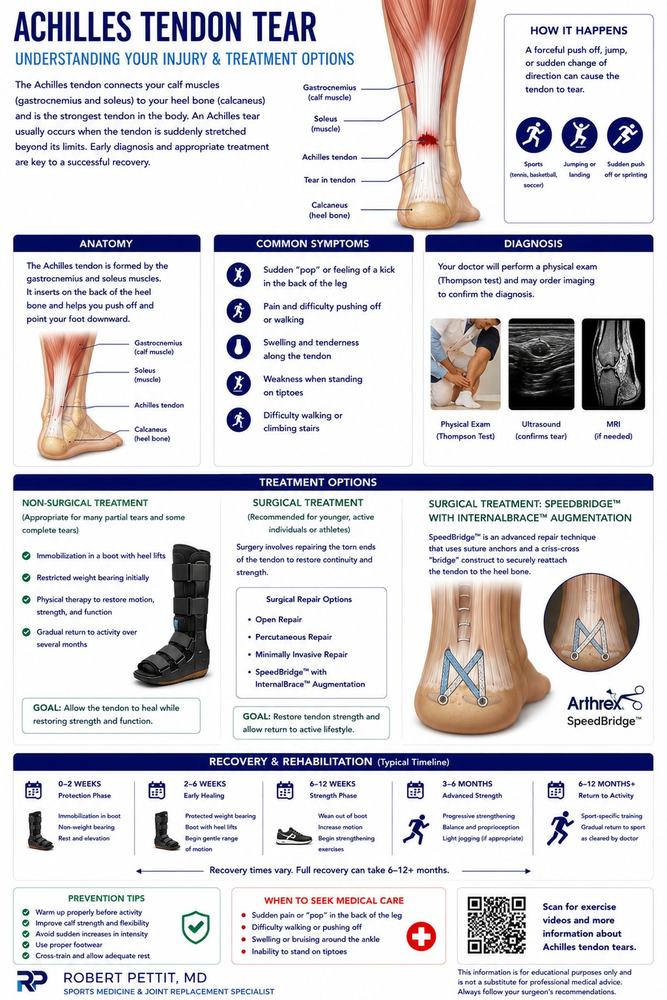
The Achilles is the strongest tendon in the body, transmitting calf power to the heel for every step, jump, and sprint. Ruptures typically strike recreational athletes in their 30s–50s during explosive push-off. The diagnosis is usually clinical — a palpable gap and a positive squeeze (Thompson) test — confirmed with imaging when needed.
Surgery vs. non-operative care
Both can work; the decision weighs age, activity, gap distance, and re-rupture risk tolerance. Surgical repair re-approximates the tendon ends directly and is favored for younger, athletic patients seeking maximal push-off strength; structured non-operative functional bracing is reasonable for selected patients. Dr. Pettit walks through both honestly.
The repair & early protection
Repair reconnects the tendon through a limited incision. Early recovery protects the repair: splint and boot with heel wedges, non-weight-bearing for the first three weeks, then progressive weight bearing from week four — advancing about 25% of body weight per week to full weight in the boot by week eight. Wedges come out one per week (weeks five through seven) to gradually bring the heel down; no stretching the tendon past neutral until the boot is weaned.
Getting back to sport
Strengthening builds from weeks seven to eight (heel-raise progression), with a return-to-run program once functional testing shows at least 80% symmetry — typically five to six months — and return to sport at six or more months with 90%+ symmetry. The re-rupture danger zone is weeks six through twelve, when the tendon feels better than it is; the boot-wean discipline exists for exactly that reason.
Pain control after surgery
Frequently asked questions
Can an Achilles rupture heal without surgery?
Yes, with strict functional bracing protocols — at the cost of somewhat higher re-rupture risk and potentially less push-off strength. Young and athletic patients usually choose repair; the decision is individualized.
How long am I in the boot?
The boot with heel wedges runs about eight weeks, transitioning to a sneaker with a heel lift for weeks nine through twelve.
When can I walk normally?
Full weight bearing in the boot by week eight, normalizing gait in shoes over the following month as strength returns.
When can I run and play again?
Running typically starts at five to six months once testing shows 80%+ symmetry; sport at six or more months with 90%+. Blood-thinner prophylaxis and DVT vigilance matter early — calf immobilization is high-risk.