Shoulder replacement in Cincinnati and Northern Kentucky
Dr. Robert Pettit is a fellowship-trained, board-certified orthopaedic surgeon who performs anatomic and reverse total shoulder replacement, planned from your CT scan, for arthritis, rotator cuff arthropathy and complex fractures that no longer respond to injections and therapy.
- Board certified, ABOS
- Sports medicine fellowship, Harvard & Tufts (NEBH)
- CT-planned implant position
- Same-week appointments
- 4.9★ · 361 Google reviews
Is this surgery right for you?
- X-rays show bone-on-bone shoulder arthritis, or a large rotator cuff tear that has led to arthritis (cuff-tear arthropathy).
- Pain wakes you at night and limits reaching, dressing and lifting despite injections, therapy and activity changes.
- You are ready for a sling period of about six weeks and the staged therapy that makes a new shoulder work well.
If you are not sure, that is what the first visit is for. Most shoulders are evaluated with an exam and X-rays; a CT scan is ordered once replacement is the plan, because it is how the implant position is decided.
At a glance
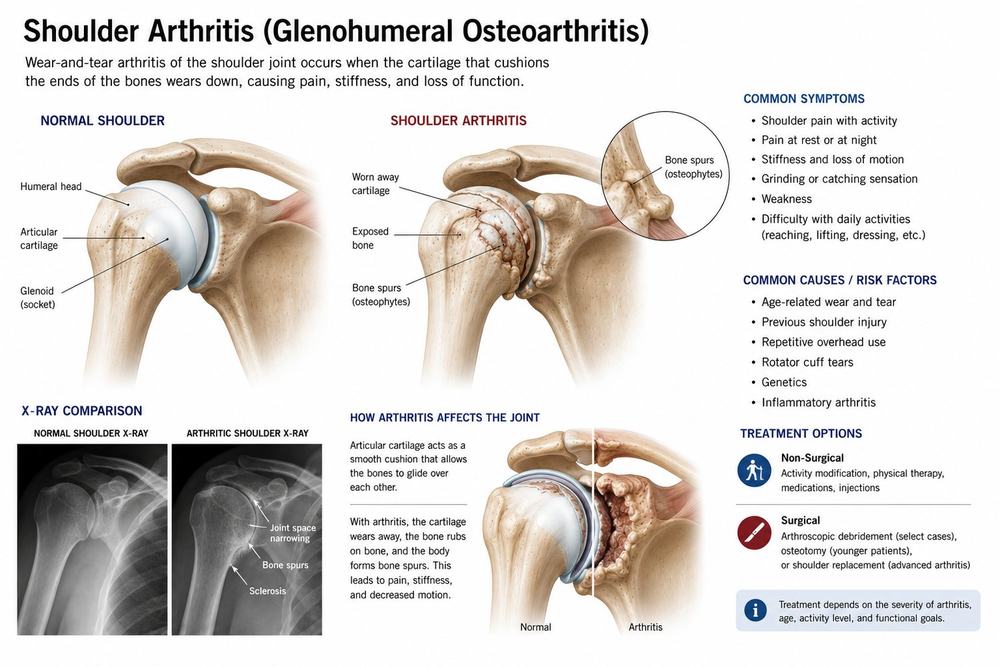
Tap to open the full-size infographic.
How Dr. Pettit approaches shoulder replacement
Two designs, one decision that matters
An anatomic total shoulder resurfaces the ball and socket in their normal arrangement and is the right choice when the rotator cuff is intact. A reverse total shoulder swaps the ball and socket so the deltoid powers the arm, and is the design of choice when the cuff is deficient, for cuff-tear arthropathy, and for many complex fractures. Choosing correctly is the surgeon's job, and it starts with your cuff.
Planned on your CT before the first incision
Every shoulder replacement Dr. Pettit performs is planned from a pre-operative CT scan that maps your bone and wear pattern in 3-D. Implant size, position and version are decided before surgery rather than estimated in the operating room, which matters most in worn, asymmetric sockets.
Protecting the repair, then restoring motion
Anatomic replacements protect the subscapularis repair early: a sling for four to six weeks with staged motion and no active internal rotation at first. Reverse replacements wear a sling for six weeks with simple dislocation precautions for twelve, progressing from passive to active motion as the shoulder heals. You leave with a written protocol your therapist follows.
Opioid-sparing protocol
A nerve block at surgery, then Journavx (suzetrigine), scheduled Tylenol and an anti-inflammatory, with a small narcotic supply for breakthrough pain only. Most patients need few or no narcotic tablets and recover with less nausea and grogginess.
Replacement is not always the first step
Injections, therapy and, for the right patient, arthroscopic debridement or biologics can buy years. If a joint-preserving option is realistic, Dr. Pettit will tell you.
What recovery looks like
- Day 0–1Surgery takes about two hours. Home the same day or after one night, in a sling, with the nerve block still working.
- Weeks 1–6Sling on; gentle pendulum and elbow/wrist motion, then guided passive motion. No driving while in the sling.
- Weeks 6–12Sling off; active motion and light strengthening. Most patients sleep through the night and return to desk work.
- Months 3–6Strength and reach keep improving; many patients return to golf around four months after an anatomic replacement.
Timelines are typical, not promises. Your written protocol is individualized to your shoulder and the design used.
Go deeper
Patient guide: anatomic vs. reverse, planning, expectations
Preparing for anatomic shoulder replacement
Preparing for reverse shoulder replacement
Post-operative protocol: reverse total shoulder
Journavx before surgery: the non-opioid pain medicine we prescribe
“He gave my husband hope again by fixing and taking the pain out of his shoulder.”
Google review, shoulder surgery
Questions patients ask
Do I need an anatomic or a reverse shoulder replacement?
Your rotator cuff decides. An intact cuff with arthritis favors an anatomic replacement; a deficient cuff, cuff-tear arthropathy, or certain fractures favor a reverse. Dr. Pettit makes the recommendation from your exam, X-rays and CT or MRI.
How long is the sling worn?
About four to six weeks after an anatomic replacement and six weeks after a reverse. No driving while in the sling; the sling comes off for prescribed home exercises.
Will I be able to reach overhead again?
Pain relief is the most reliable result and most patients sleep through the night within weeks. Anatomic shoulders commonly reach 140-150 degrees of elevation; reverse shoulders typically reach functional overhead motion of 80-120 degrees or more.
Are there permanent restrictions?
Reverse shoulders carry lifetime common-sense limits, commonly around 15 lb below shoulder height and 10 lb overhead, and avoiding repetitive heavy pressing. Anatomic shoulders have few limits once healed.
Where is surgery performed?
Good Samaritan Hospital (TriHealth) or a Beacon surgery center, depending on your health and insurance. Most patients go home the same day or after one night.
See Dr. Pettit this week
Book directly into Dr. Pettit's schedule, or leave your details and our team will call you within one business day.
Book online now (513) 354-3700Most major insurance plans accepted, including Medicare. Bring any imaging you already have.
- Fort Thomas, KY, 775 Alexandria Pike (Mon & Tue AM, Thu PM)
- Beacon East, Anderson (Tue PM)
- Red Bank, Hyde Park (Thu AM)
- Beacon West, Western Hills (Wed AM)
- Finneytown (Mon PM)